navbar

Thursday, 26 January 2023

Amazing medical alert and assistance dogs - trained to save lives


Animal lovers already know that many creatures, including dogs, have the power to calm and de-stress humans, and they can often sense our moods. But some can do something even more amazing. 

With training, they can detect a potential medical episode or emergency before it begins, giving enough time to alert the person to take preventative action. They can also be trained to provide valuable support to those requiring physical or emotional assistance.

There are different types of training depending on what type of assistance the dog will provide. 
Broadly, these are the three types of support dog:

Assistance dogs provide support for various conditions, including Autism, where they are trained to
provide a sense of safety and reduce stress in social environments. Below, you can read about the rigorous process for training dogs to ultimately become assistance dogs, and how they help to keep their owner safe.

Medical alert dogs are trained to provide a reliable alert for those who experience potentially dangerous medical conditions, such as epileptic seizures, for example. Some can even detect various types of cancers from a urine sample.


Disability assistance dogs help people with physical limitations and disabilities, as they are trained to
perform specific tasks.
Training an assistance dog can take up to two and a half years, and most animals are acquired and trained by special charities that rely on donations.
In the UK, Helpful Hounds, Support Dogs, and Medical Detection Dogs are all charities that provide
training and support for the identification and training of dogs, and for their future owners.

The journey to becoming an assistance dog


Puppies destined to become assistance dogs are identified at a very young age. Pups need to be sociable and confident, as well as enjoy human interaction. They must also be healthy and active.
Some charities have volunteer breed stock holders who own special breeding females whose pups are temperamentally suited to assistance. They live with a volunteer family at home, and are mainly
Labradors, Golden Retrievers and Working Cocker Spaniels, as these breeds are well suited because they love to carry and retrieve, and are happy to work with people.


Puppies are trained from a young age to become an assistance dog


Aged around 8 weeks, the puppy is placed with a volunteer puppy socialiser who looks after him for the next 18 months. As well as the usual responsibilities of looking after a growing puppy, the socialiser begins to develop the pup's training. They are socialised, are acclimatised to meeting different people, and learn to become comfortable in different environments.


At around 14-18 months of age the youngsters move to a training centre, where they begin to learn tasks such as walking next to a wheelchair, and picking up dropped items and handing them back. It is here that the matching process with a potential owner begins. The dogs get plenty of 'downtime' where, just like any dog, they can play, run and interact with other dogs.


During advanced training the dog will learn to meet the specific needs of the person for whom he'll
provide support, and also learn to feel comfortable with that person. He or she needs to learn that
mobility aids are part of the owner's needs, to retrieve items on command, to provide an alert if the
owner requires it, and help with, for example, dressing or getting up.


Some dogs help support children with Autism, and learn how to distract the child during behaviour that a parent wants to interrupt, helping the child to focus and stay calm in a challenging environment.

There is ongoing support through a transition period of settling into a routine with the new owner, to help to develop this lifelong partnership.
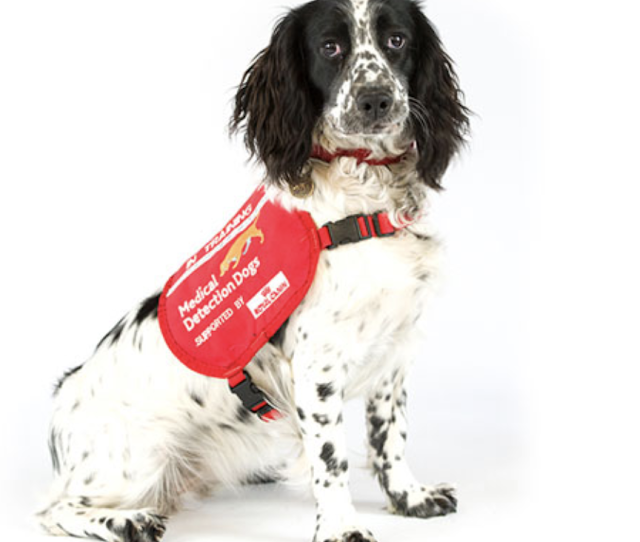


Image (c) Medical Detection Dogs


Dogs who will be used for medical detection are trained to employ their incredible sense of smell to
identify minute changes that indicate a particular medical episode (for example an epileptic fit or a
diabetic coma) is imminent. By alerting the owner, he or she can take preventative action to avert danger.
Again, long and specialist training is required to ensure that the dog's scenting skill is accurate, and that mutual trust exists between dog and owner.
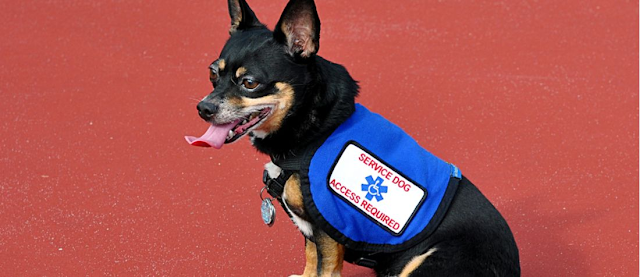

Service dogs come in all shapes and sizes


All of these dogs are highly skilled in specialist areas, using their amazing senses to support people, and providing valuable help as well as being much loved and loyal companions.

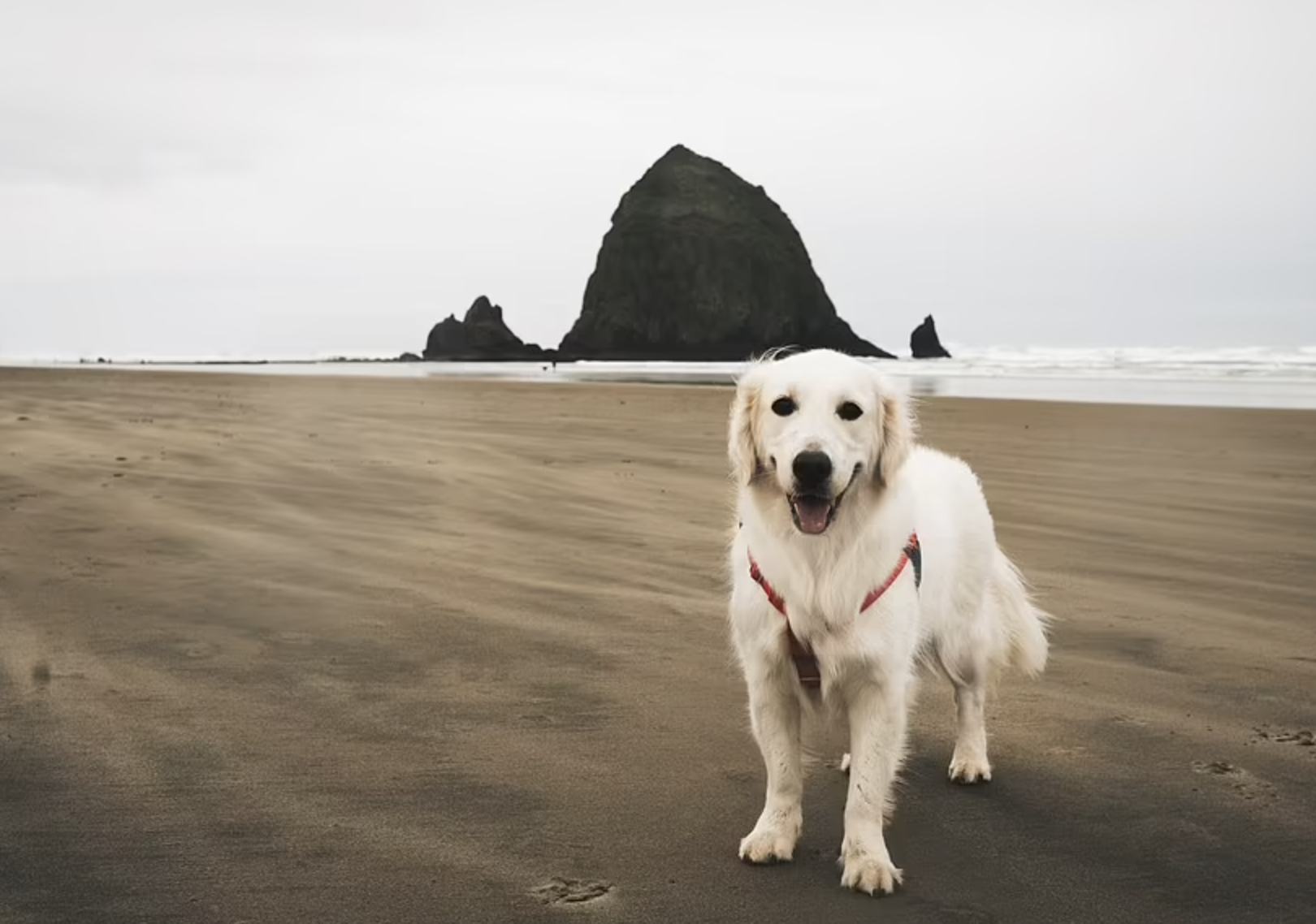
Thursday, 15 December 2022

Globetrotting service dog Finnian becomes a social media star

Finnian the Golden Retriever is a medical alert service dog whose primary job is cardiac alert for his owner. 

He has amassed a huge following on Instagram and TikTok, that enjoys seeing his travels around the world with his owners and their two other dogs. Finnian’s family live in Massachusetts, and travel around the US in their converted van, as well as venturing further afield, overseas.


     (c) Finnian, pictured on his travels


Finnian, who has lived with his owner since he was two months old, has formed an extremely strong bond with her, that travelling together has helped to strengthen; she has complete trust in Finnian to alert her should a medical episode occur. Finnian has a fulfilled life, exploring new destinations including Spain, France, Gibraltar, Iceland and Canada, as well as half of the American states. His globe-trotting is captured in photos shared via his social media accounts.


Finnian’s travel companions are Lacey, a six-year-old Pomeranian, and Keegan, a four-year-old Goldendoodle.


Finnian and Lacey are pictured below.


     (c) finnianthegoldie


Finnian has enjoyed trips to several European destinations including Madrid, Spain (below). He enjoys an adventure, and one of the most viewed posts was of him exploring canyons in Utah using an abseiling-type harness that helped him to access the rocks safely.


            (c) finnianthrgoldie


You can follow Finnian’s adventures at:

www.instagram.com/finnianthegoldie

www.tiktok.com/@finnianthegoldie

Thursday, 10 November 2022

Yellow Dog UK - some dogs need their space


Have you heard about 'Yellow Dogs'? No, not adorable Golden Labradors, but a campaign to raise awareness that some dogs need space.

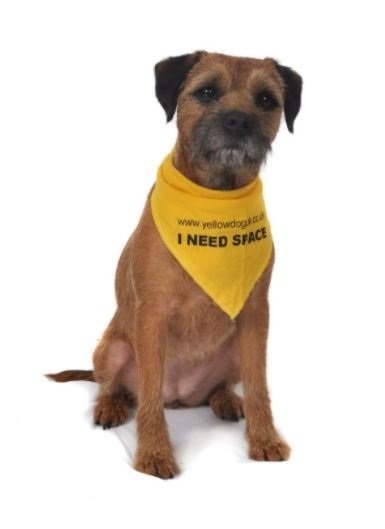
This is done by the dog wearing yellow to alert other dog owners and passers-by. Yellow Dog UK is part of an international initiative introduced in 2012 to increase awareness for dogs who need space whilst they're training, recovering from surgery, or being rehabilitated, for example.

(c) Image thanks to Yellow Dog UK


The concept was originally developed by Swedish dog behaviourist Eva Oliversson, recognising that a clear signal to others that a dog needs space will help his behaviour and enable him to feel more safe and secure. Indicated by wearing yellow, at first this was by yellow ribbons, but a whole range of yellow jackets, collars and bandanas are now available.

There can be a number of reasons for a dog wearing yellow. He may be a rescue animal who is being rehabilitated, or he may have health issues that make him nervous or vulnerable. Other reasons include his having had a bad experience with other dogs: for example by being attacked, or a bitch who is on heat.
Any of these reasons can lead to a dog needing space, and this should be respected both by other dog owners, and those who simply want to greet or pet the dog.

In the UK, 'Yellow Dog UK' at https://www.yellowdoguk.co.uk/ provides a lot of helpful information and advice, as well as enabling owners to buy from a range of yellow merchandise for dogs to wear. Owners can contact Yellow Dog UK for  free poster and ribbon, too.

If you think your dog would benefit from wearing a 'yellow dog' identifier, the website is a great place to start.


                                                 (c) Image thanks to Yellow Dog UK


Yellow Dog UK also promotes dog ownership and encourages both children and adults to always ask permission before touching a dog who they don't know. 

Promoting responsible and careful dog ownership, as well as the 'Yellow Dog' message, is worthwhile for all dog owners and lovers. Let's hope more take it up in the future.

Check out Hubble & Hattie's range of helpful books on dog behaviour, including:


Thursday, 13 October 2022

Do Animals Feel Emotion?

     Contented?


When you look at the images in this blog, what do you see? A relaxed happy cat, and a sad lonely dog? Or are we simply imposing our human emotions upon animals, because that’s what we think they are experiencing and expressing?

We’ll never know for sure, of course, whether animals’ brains are wired in the same way as ours, so we can only observe their behaviour and interpret it as best we can, based on our own emotions and learned behaviour. Owners believe that they understand how their pets are feeling through their behaviour and body language, and, let’s be honest, animals have also learned to be pretty good at communicating what they want to us, whether it’s their food bowl topped up, a walk, or just some pampering!

However, how much they really feel we’ll probably never know. Humans are very good at anthropomorphising creatures. Just look at the number of cartoon and fictional animal characters who speak, dress and interact with each other just like people. This must influence our perception of animal behaviour, if only subconsciously.

The jury is still out as far as science is concerned. Philosopher Philip Godfrey-Smith’s work Metazoa: Animal Life and the Birth of the Mind' explores three behaviours that provide clues in animals:


Do they tend to and protect injured body parts?

Most creatures except insects do

Do they consider costs and benefits?

Some do, for example by tolerating minor pain in order to be safe

Do they seek pain-killing chemicals after injury?

It’s been proven that some animals will opt to undertake behaviour that alleviates pain


    Sad and lonely?


But behaviours and emotions are different. It can be argued that animal behaviour is, to a large extent, instinctive and reactive: ie. driven by hunger or self-preservation. Reactions between different creatures to fear and threat also show that we can’t interpret behaviour consistently across species. Some may ‘freeze’ when threatened; others may run, and some attack. Some may do nothing at all. So even the ‘fight or flight’ response that we humans instinctively show is not the same for animals.

Ultimately we may never completely understand how animals experience the world. We know that some of their senses (sight, smell, hearing) are more highly developed than our own, whilst others (communicating) are less so.

Perhaps it’s best to simply respect and admire their differences to us, and enjoy the fact that we can share our lives with domesticated creatures who enjoy our company.


Thursday, 15 September 2022

Sight and scent are strongly connected for dogs

A new study has discovered that dogs have an extensive pathway in their brains that enable them to 'see' as well as sniff with their highly-developed sense of smell.

Scientists in Cornell University, New York, found that sight and scent is integrated in dogs, to the point where even blind dogs can function extremely well by navigating their environment by smell.

All dog owners know how much dogs like to sniff, and navigate their way around by their nose. This new research, carried out on 23 dogs of various breeds, revealed through MRI scans that big neural pathways, or “information highways” exist between the olfactory part of the brain (responsible for interpreting the scents from the nose) and the part of the brain tied to vision. This pathway that links smell to vision isn’t found in people but is “thick and obvious” in the dog’s brain.

This appears to confirm that in dogs, the sense of smell is so highly developed that seeing and smells are interlinked in a dog’s perception.


As humans we can only imagine what the world must be like for dogs. Everything must be ‘hyper-real’ with a scent to accompany all they see. As owners, we must respect the dog’s need to stop and sniff at every opportunity. Sniffing and storing information is an enriching experience for dogs, and we can only admire their sensory powers.

Humans do of course utilise dogs’ highly developed smelling skills for tracking, by training sniffer dogs to search out certain substances or to track missing people.


Sniffer dogs play a vital role at airports

This research is just starting, as the same team want to investigate cats’ link between scent and sight, as it is believed that cats have the same strong neural pathways as dogs. Watch (or sniff!) this space.


Thursday, 28 July 2022

Paws on board? Dogs in cars – how to travel safely with your dog on board


Inevitably, your dog will travel in the car with you, whether you’re off on a well-earned break, or simply going out and about for a long walk somewhere. But thinking about the options for the safest way for you and your dog to travel in the car together is not a subject that all owners consider fully.

It’s important, as making sure that your dog is restrained properly is part of the Highway Code. Dogs can and do cause accidents when the driver is distracted by them in the vehicle.

Certainly there are plenty of options on the market for the dog-owning motorist. So whether it’s a dog car seat, a seatbelt and harness, or a grille that keeps them safely in the back, there’s lots to consider.

The size and strength of the dog is a key factor. Whilst some car seats may look cute and appealing, they are usually only suited to small and lightweight dogs, and may not provide enough security and protection to the dog if the vehicle were to be involved in a crash. They may not restrain a heavier or more active dog safely, putting both dog and owner at risk of injury.

Not all dog car seats have been tested in crash conditions, and of course dogs come in many shapes and sizes, so a ‘one size fits all’ product is not going to be right for many.

Moreover, owners have different views about what is the best way for their dog to travel in the car. Some owners of small dogs prefer a sturdy strap that attaches to the dog's harness and the seatbelt rather than a car seat.


A sturdy metal grille (or sometimes a crate) may give both owner and dog a sense of security, because the dog is safely contained in the back of the vehicle. These are usually used for larger dogs. However, the dog is not usually restrained within the space in the hatchback or boot, so should there be a collision he or she would be thrown around in the area or within the crate, likely causing them injury.

A safer alternative to a crate or grille is a crash crate; these have been designed not to deform during an accident, built to withstand side, front and rear impacts, with some also preventing damage caused by cars rolling. You will, of course, pay a premium for this level of protection, but you'll get much better protected from rear-end shunts and side impacts than with a normal crate.

Do consider carefully the safest and most comfortable way of securing your dog when travelling by car. It could help to save both you and your dog’s life in an accident.


Thursday, 16 June 2022

Paws on Board – get on board with your canine companion!

Surf school for dogs takes off in Dorset


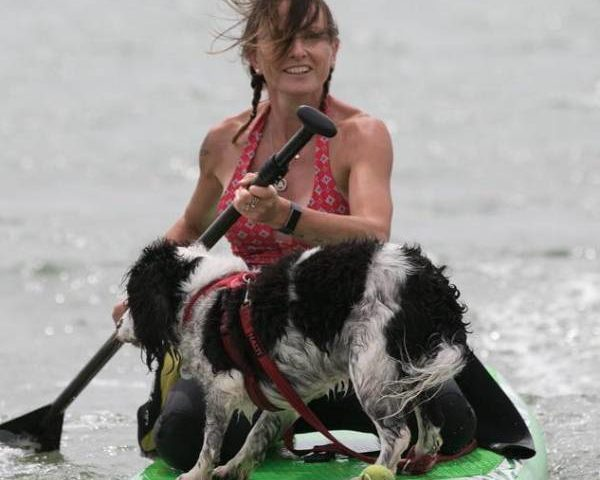
Vicky Mansfield, based on the Dorset coast, has used her ethical dog-training skills to branch out into making the most of the ideal beaches around Bournemouth and Poole by offering to teach dogs to surf with their owners!

A lifelong dog lover, Vicky has immersed herself in all things dog-related for as long as she can remember. A believer in ethical training methods without fear, pain or punishment, she is a member of The School of Canine Science, The Dog Training Academy, The Victoria Stilwell Academy and Dr Dunbar’s Dog Behaviour and Training Academy. Vicky lives and breathes dogs, and loves sharing her knowledge and passion with others.


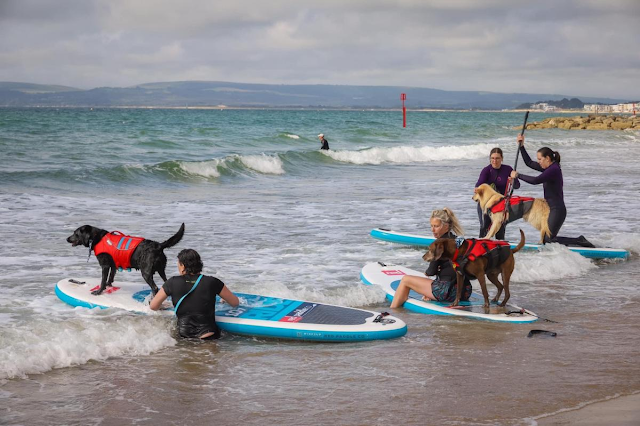
As well as offering dog and puppy training, dog owners can immerse themselves (quite literally!) in the Dorset waves, accompanied by their dog on board! By teaching the dogs confidence and calmness in the water, both dog and owner can enjoy the waves safely. All that’s needed, alongside Vicky’s training, is the hire of a dog-safe surfboard and lifejacket. Vicky believes in slow learning techniques that help the dog to digest information in their own time, rather than forcing behaviour on them.


     Dogs and owners start to catch the waves


Paws on Board offers the only dog surfing lessons in the area. By building confidence, balance and behaviour on a board, it offers a unique way to bond with your canine companion whilst having fun and learning new skills. The organisation was recently recognised by the local newspaper, the Bournemouth Echo, as a ‘Trader of the Week’ for the enterprising way that Vicky has developed the business.


If you would like to find out more about Paws on Board, the website has lots of useful information:

https://pawsonboard.co.uk/


     Getting ready to hit the surf


All photos with thanks and credit to Paws on Board.https://pawsonboard.co.uk/